




We’ve reached April 1, which is a key date in assessing where things stand with snow in the mountains, which then informs the likely water supply in streams and rivers later in the spring and summer. The peak in snowpack actually tends to arrive a bit later than April 1 at higher elevations and the northern part of the state, but April 1 is when manual snow course measurements have historically been made, so it serves as a useful point of long-term comparison. There’s no sugar-coating the data right now: after the record-smashing heat in March, the mountain snowpack is in historically bad shape for April 1.
First, a few updates on the March heat
As of our last blog post about the March heat wave, the statewide March temperature record had been tied, but not broken. It only took a couple more days for that to happen. The previous March record of 96°F from Holly in 1907 was broken with highs of 99°F at Burlington on the 25th and at Campo on the 26th. (Temperatures at Springfield and Walsh also exceeded the previous March record, reaching 98 and 97 respectively.)
Here’s one more way to look at how extreme and prolonged the heat was in March. This map shows that broad swaths of Colorado had more than 7 days with high temperatures warmer than any March temperature from 1951-2025. That’s right: a whole week’s worth of days that were warmer than any March day in the last 75 years. On the Eastern Plains, it was “only” 2-5 days warmer than previous March records. The one exception in this dataset is the highest elevations in the mountains. There’s not a lot of reliable temperature data up above treeline, so we’re not sure whether this is correct or not.

We’ll round up more of the records in our monthly summary that will go out next week. (If you’re subscribed to get these posts via email, you’ll get those summaries too. If you aren’t subscribed, the sign-up box is at the bottom of the page!) But there’s no question that this will go down as the warmest March on record for Colorado—around 3-4°F warmer than any other March in the last 132 years—once all the numbers are tallied.
We wish the snowpack numbers were an April fool’s joke
If you’ve read anything about the mountain snowpack this year, you might be sick of seeing this graph. But it’s worth another close look because of how incredible it is, and not in a good way.

As of April 1, the snow water equivalent (the amount of liquid water stored in the snow) averaged across the 115 SNOTEL stations in Colorado was 3.3 inches, just 22% of the 30-year median. The previous low in the SNOTEL era (back to 1987) on April 1 was in 2012, which had 9.1″ on April 1. That means that we currently have less than 40% of the water in the snow than the previous lowest year.
Amid the record-shattering heat in the 2nd half of March, statewide snowpack declined by nearly 5 inches. Previously, the fastest decline in a 2-week period before April 1 was 2.3″ in 2012, one of the worst years for spring snowpack. Only two times has the SWE dropped by more than 5″ in two weeks before the end of April, in 1987 and 1989 which were both years with above-average peaks that started melting on the early side.
The peak SWE this year, again averaged across the SNOTEL stations in Colorado, was 8.55″ on March 9. That peak is just 51% of the median peak, nearly a month earlier than average, and is the lowest peak of the SNOTEL era.
As discussed in previous posts, the other key points of comparison for past snow droughts were 1977 and 1981, when SNOTEL stations either didn’t yet exist (1977) or were not as widely distributed as they are now (1981). In some of the southern mountain ranges, the peak SWE in early March this year may have been slightly higher than it was in those years. But in both of those years—like nearly every other year—the SWE increased substantially between March 1 and April 1. We know that’s not what happened this year. This year’s April 1 SWE was lower than those years almost everywhere in the state. It’s now safe to conclude that this has been the worst year for Colorado snowpack in recorded history.
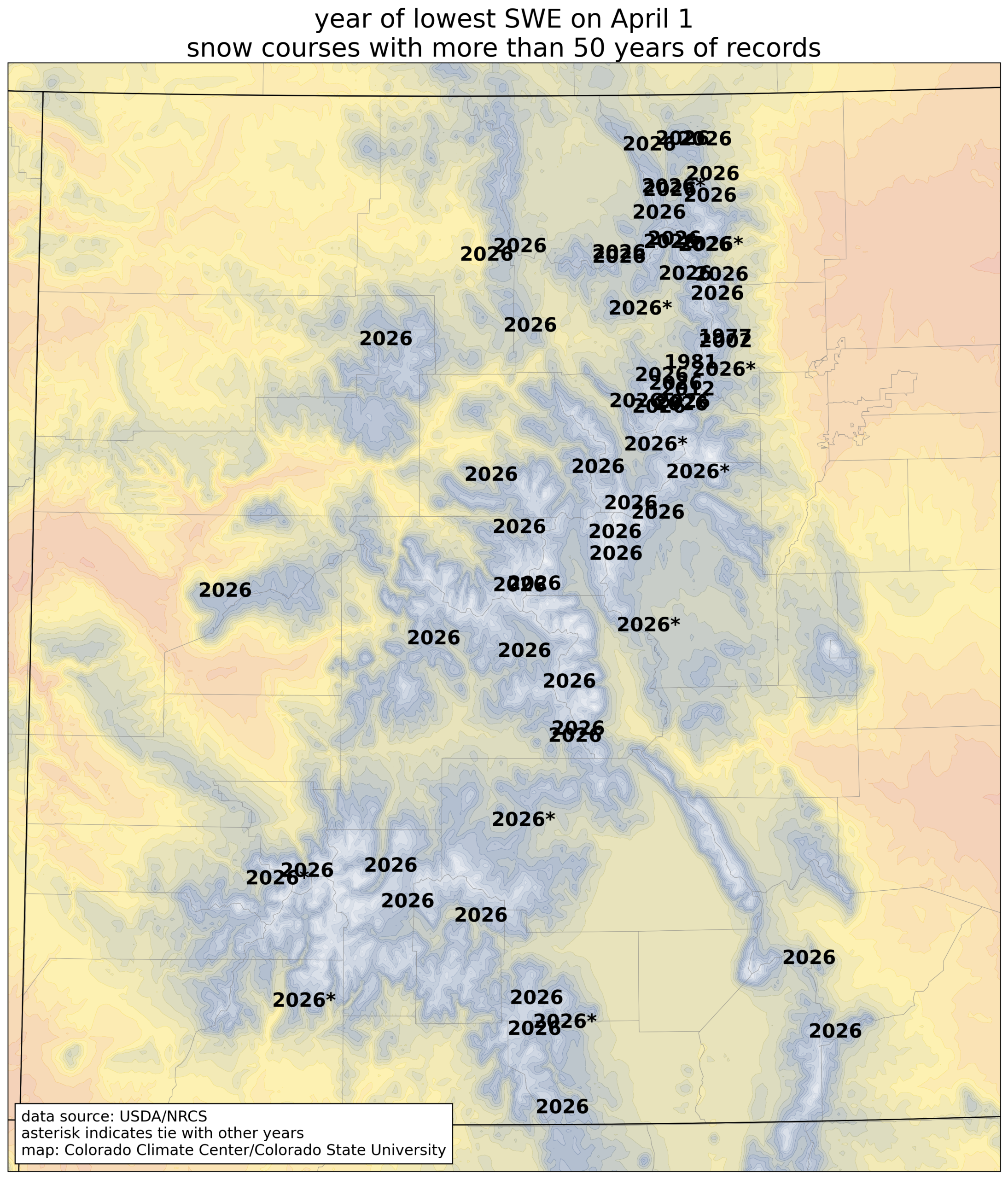
Many of the April 1 snow course measurements are now in, and at 60 of the 64 sites with at least 50 years of data, the SWE in 2026 was the lowest or tied for the lowest on record.
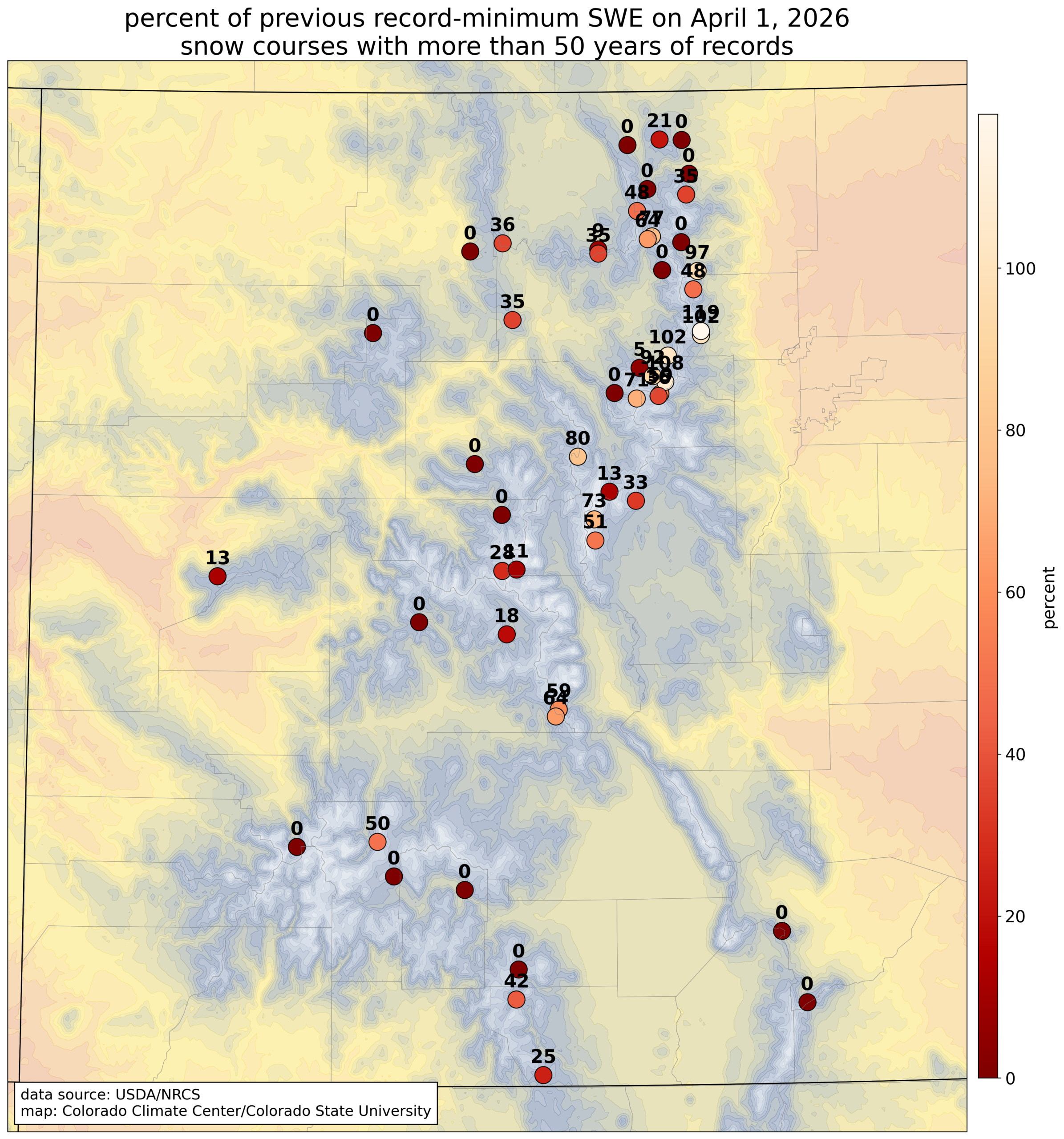
Perhaps more shocking is how much less SWE there was than in any previous years. The map below shows the percent of the previous record low at sites with more than 50 years of data. Most locations have less than half of the previous record low, and several locations that have never before had less than 5 or 6 inches of SWE on April 1 have no snow on the ground this year. Eighteen of the 64 snow course sites observed zero SWE this year and had never previously been snow-free on April 1st.
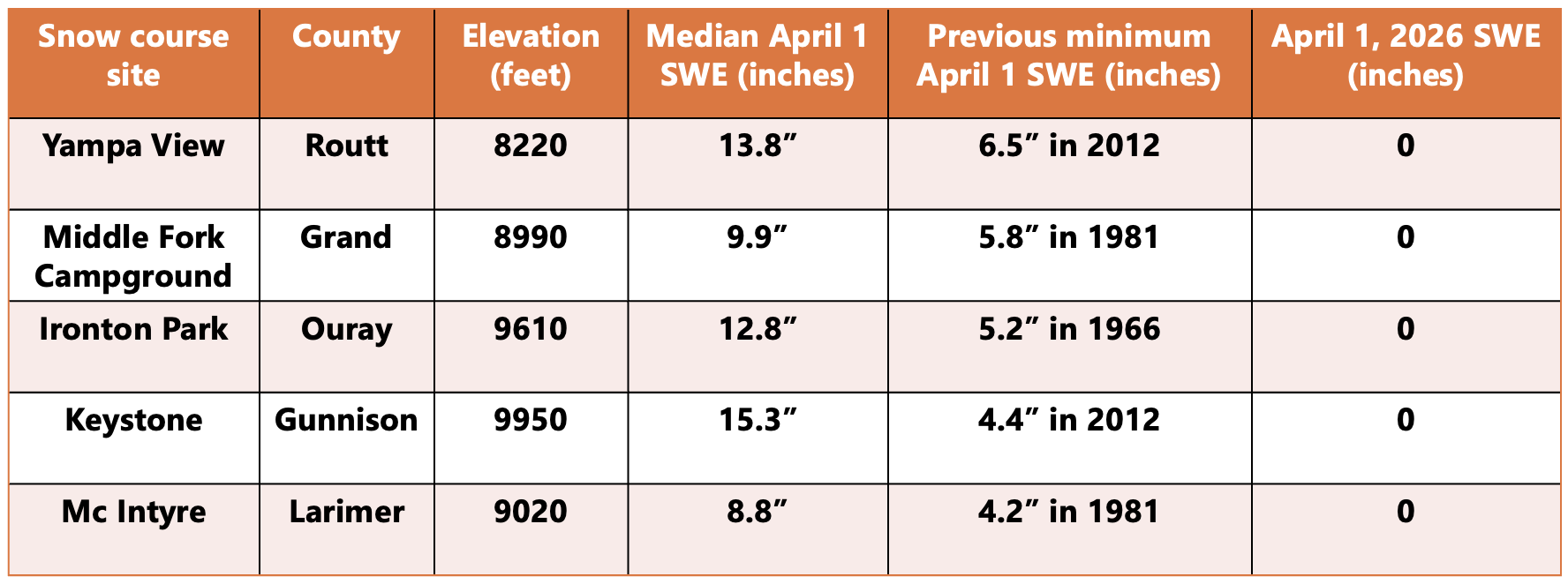
The long-term measurement site at the Rocky Mountain Biological Laboratory in Gothic estimated that the spring snowpack in parts of the Gunnison Basin was unprecedented, with a return period of hundreds of years. The Colorado Dust on Snow program (CODOS) has numerous photos of the poor snowpack on their blog.
Drought conditions and what to expect in April
Now, it’s important to remember that not all of the water that was in the snow earlier in the winter has disappeared (though some of it did, to sublimation). That water is going into the soils and the rivers now. The rivers will therefore also be peaking very early: rivers that typically have peak flow in late May or early June will likely peak sometime in April. This means extremely low flows in summer are likely, unless there’s an unusually wet late spring.
This week’s US Drought Monitor summarizes the effects of the recent conditions across Colorado. Almost the entire northwestern quarter of the state is now in D4 (exceptional) drought, going back to a dry spring and summer in 2025 and a terrible winter and early spring this year. The D4 coverage of 21.59% is the largest since February 2021.

The one bit of good news is that April has started off like April, rather than whatever the March-June hybrid was that we just went through. Widespread precipitation fell in western Colorado, with snow in the mountains and rain at lower elevations. Some locations in southwestern Colorado that had zero precipitation in March, received well over an inch of precipitation between Tuesday and Wednesday. (Note that the Drought Monitor map shown above only includes data through early Tuesday morning, so the recent storm is not reflected.) Some of the mountain SNOTEL sites that had gone snow-free at the end of March have snow on the ground again!
This storm didn’t come anywhere near alleviating the snowpack and water deficits that have arisen in the last few months. But any water from the sky is very welcome at this point! The outlook for the rest of the month does appear to be April-like as well: probably warmer than average, but with more active weather than March had. This should help to slow down the melting of the little snow that remains, and perhaps give some temporary increases in snowpack that at the very least keep the situation from degrading as quickly as it has been.
 Allie Mazurek
  Peter Goble